

Cargo vs Cabin Pet Travel: Which Is Safer?
August 1st, 2026 | Uncategorized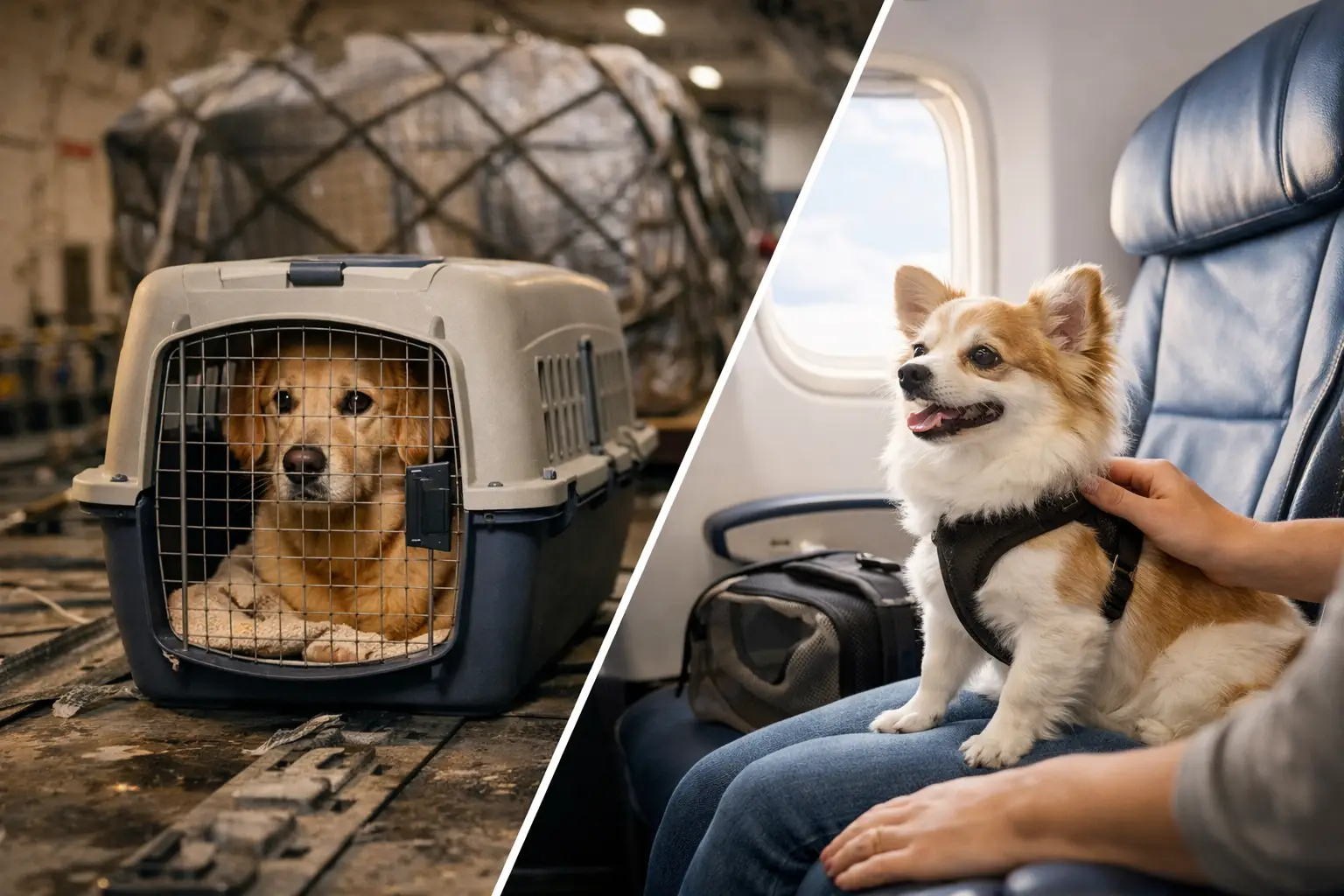
A pet’s place on the aircraft can feel like the most consequential decision of an international move. In the cargo vs cabin pet travel decision, the right answer is not simply whichever option feels closest to you. It depends on your pet’s size, temperament, health, route, airline policies, connection times, and the entry requirements at your destination.
For many families, an in-cabin flight is ideal when it is available. For others, traveling in the aircraft’s temperature-controlled live-animal hold is the only compliant and appropriate option. Both arrangements can be safe when planned carefully, but neither should be treated as a last-minute airline add-on.
Cargo vs Cabin Pet Travel: The Core Difference
An in-cabin pet travels with you in the passenger area, usually in a soft-sided carrier that fits fully beneath the seat in front of you. The carrier remains closed during the flight, and the pet counts toward the airline’s cabin-pet allowance. Space is limited, so this option is generally reserved for small dogs and cats that can stand, turn around, and lie down comfortably within the airline-approved carrier.
Cargo travel usually means a pet travels in a secure, airline-compliant travel crate in a designated, pressurized, and temperature-controlled section of the aircraft. On many flights, this area is part of the same lower-deck environment used for live animals, although airline procedures and aircraft configurations vary. Pets traveling this way are checked in through a dedicated process and collected at the destination according to airline, customs, and import procedures.
The word “cargo” understandably worries pet owners. What matters most is the actual travel plan: the airline’s live-animal program, the aircraft type, weather conditions, crate setup, ground handling procedures, layovers, and the people coordinating every step.
When Cabin Travel Is the Better Fit
Cabin travel can be a good choice for a small, healthy pet who settles quietly in a carrier and is flying on a direct or relatively simple route. You remain nearby throughout the journey, which can provide reassurance for both you and your pet. You also handle check-in and arrival together, subject to destination inspection procedures.
That proximity does not mean cabin travel is automatically low-stress. Airports are noisy and crowded. The carrier must stay under the seat, and your pet cannot be removed during the flight. A pet that becomes distressed in confined spaces, vocalizes continuously, or needs frequent breaks may find the cabin challenging.
Cabin availability is also limited. Airlines set their own size and weight limits, restrict the number of pets allowed in each cabin, and may prohibit cabin pets on certain routes or aircraft. International journeys can add further complications, particularly where a connecting airline has different rules or where the destination requires specific inspection and release procedures.
A well-chosen cabin plan is about more than booking early. Your pet should be comfortable in the carrier long before travel day, and the carrier dimensions must meet the operating airline’s rules for every flight segment.
Cabin travel may be appropriate when:
A pet is small enough for under-seat travel, comfortable resting in a carrier, and traveling on an itinerary with consistent airline policies. It also works best when the owner can manage all required veterinary documents, check-in timing, and destination procedures without creating a rushed airport experience.
When Cargo Travel Is the Better Fit
Cargo travel is often necessary for medium and large dogs, pets that cannot fit safely beneath a passenger seat, and animals traveling on routes where in-cabin service is unavailable. It can also be the more practical option when a family has multiple pets or when an owner and pet must travel on separate itineraries.
For a large dog, trying to make cabin travel work is not an act of kindness. A properly sized crate in a properly managed live-animal transport program is far safer and more comfortable than an undersized space or an arrangement that does not meet airline rules.
Cargo travel requires more planning because the crate becomes your pet’s secure travel environment. It must allow the pet to stand without crouching, turn around normally, and lie down comfortably. The crate must also meet construction, ventilation, door-security, and labeling requirements. Airlines may reject a crate at check-in if it does not comply, even if the booking is confirmed.
Weather is another key factor. Airlines may apply temperature restrictions during periods of extreme heat or cold, including at transit points. This can mean changing travel dates, selecting a different route, or using a different airline. While this can be frustrating, it reflects a welfare-based decision that should be respected.
Cargo travel may be appropriate when:
A pet is too large for cabin limits, requires a rigid travel crate, or is moving internationally on a route designed around live-animal handling. It is particularly suitable when the itinerary has been reviewed for safe connection times, climate considerations, and reliable ground support at both ends.
Safety Depends on Planning, Not Just Placement
The safest option is the one that matches your pet and complies with every part of the journey. A small dog may be safer in the cabin if it can travel comfortably beneath the seat. A large dog may be safer in the live-animal hold because it has an appropriately sized crate and a route designed for its needs.
Health and behavior deserve the same attention as airline rules. Senior pets, brachycephalic breeds, pets with respiratory or cardiac conditions, and highly anxious animals may need additional veterinary assessment before travel. Some airlines restrict certain breeds or impose seasonal limits. A veterinarian can assess fitness to travel, but airline and destination eligibility must be confirmed separately.
Sedation is generally not a simple answer to travel anxiety. It can affect balance, breathing, and a pet’s ability to regulate body temperature, especially at altitude. Any medication decision should be made with the pet’s veterinarian and aligned with airline guidance. Most pets benefit more from crate acclimation, a calm pre-travel routine, and a thoughtfully timed itinerary.
The International Details That Can Change the Plan
For international moves, cabin versus cargo is only one layer of the process. Microchip requirements, rabies vaccination timing, health certificates, import permits, rabies titer testing, airline forms, and customs clearance can determine whether a pet is allowed to board or released promptly after arrival.
A route that looks convenient for people may be unsuitable for a pet. A short connection may not provide enough time for airline transfer procedures. A long overnight layover may require special handling arrangements. One carrier may accept a pet in cabin while a partner airline requires cargo transport. These details need to be reviewed before tickets are finalized, not at the airport counter.
This is especially relevant for moves involving Central America, the United States, and destinations with changing animal-health controls. Documentation standards can vary by country, species, pet age, origin, and transit location. A missing endorsement or mistimed rabies record can turn a carefully planned reunion into a delay.
Preparing Your Pet for Either Option
Start crate or carrier training weeks ahead whenever possible. Leave the travel space open at home, add familiar bedding only if permitted, and reward calm voluntary entry. Short practice sessions help your pet see the carrier as a predictable resting place rather than something that appears only on a stressful day.
On travel day, keep meals light according to veterinary guidance and ensure your pet has access to water as allowed. Avoid introducing new foods, supplements, or routines just before departure. Build in extra time for check-in, document review, and security procedures, because rushing transfers stress from owner to pet.
A professional relocation coordinator can be valuable when the itinerary involves cargo handling, complex import rules, multiple airlines, or an unfamiliar destination. Planet Pet Relocation helps families coordinate the practical details that protect a pet’s welfare: compliant documentation, airline communication, crate guidance, routing, customs support, and clear updates through the journey.
Your pet does not need the most convenient travel option. They need the right one – a plan built around their physical needs, their route, and the rules that bring them safely to the next chapter of family life.

